AISC certification tells you a steel fabricator or erector runs a documented quality management system that an independent auditor has checked. It does not certify a single building. Here is what certification covers, how it ties into special inspection, and how to check any AISC certified fabricator, including Garbe Iron Works.
What does AISC certified mean?
An AISC certified fabricator or erector has had its quality management system reviewed and audited against AISC’s certification standard, AISC 207. The audits are run by Quality Management Company, the single independent agency AISC uses, and AISC makes the certification decision. Certification is address-specific, so each facility is certified on its own.
AISC established its first certification program in 1976. A balanced committee of participants, specifiers and building officials administers it, and the standards are developed under the American National Standards Institute consensus process. AISC holds ANSI accreditation, QMC holds ISO 17020, and the audits are done by specially trained contract auditors who work for neither AISC nor QMC.
For a building fabricator, certification covers all aspects of providing structural steel fabrication, from contract receipt through final delivery, regardless of project size or complexity. It checks the system that produces the steel. It is not an inspection of one job’s pieces.
Is AISC a design code?
Certification is not; it is a quality program. AISC also writes the design side. AISC 360, the Specification for Structural Steel Buildings, is the structural steel specification incorporated into U.S. building codes, and its Chapter N covers quality control and quality assurance. The certification standards are developed by a separate committee. Your engineer designs to AISC 360; certification audits how the shop or erector controls its work.
How a fabricator gets AISC certified
Certification starts with paperwork and ends on the shop floor. AISC reviews eligibility, its audit agency reviews the company’s documents and quality manual in depth, and then an auditor visits the site. Deficiencies in the quality management system come back as Corrective Action Requests, which have to be resolved before AISC decides on the certificate.
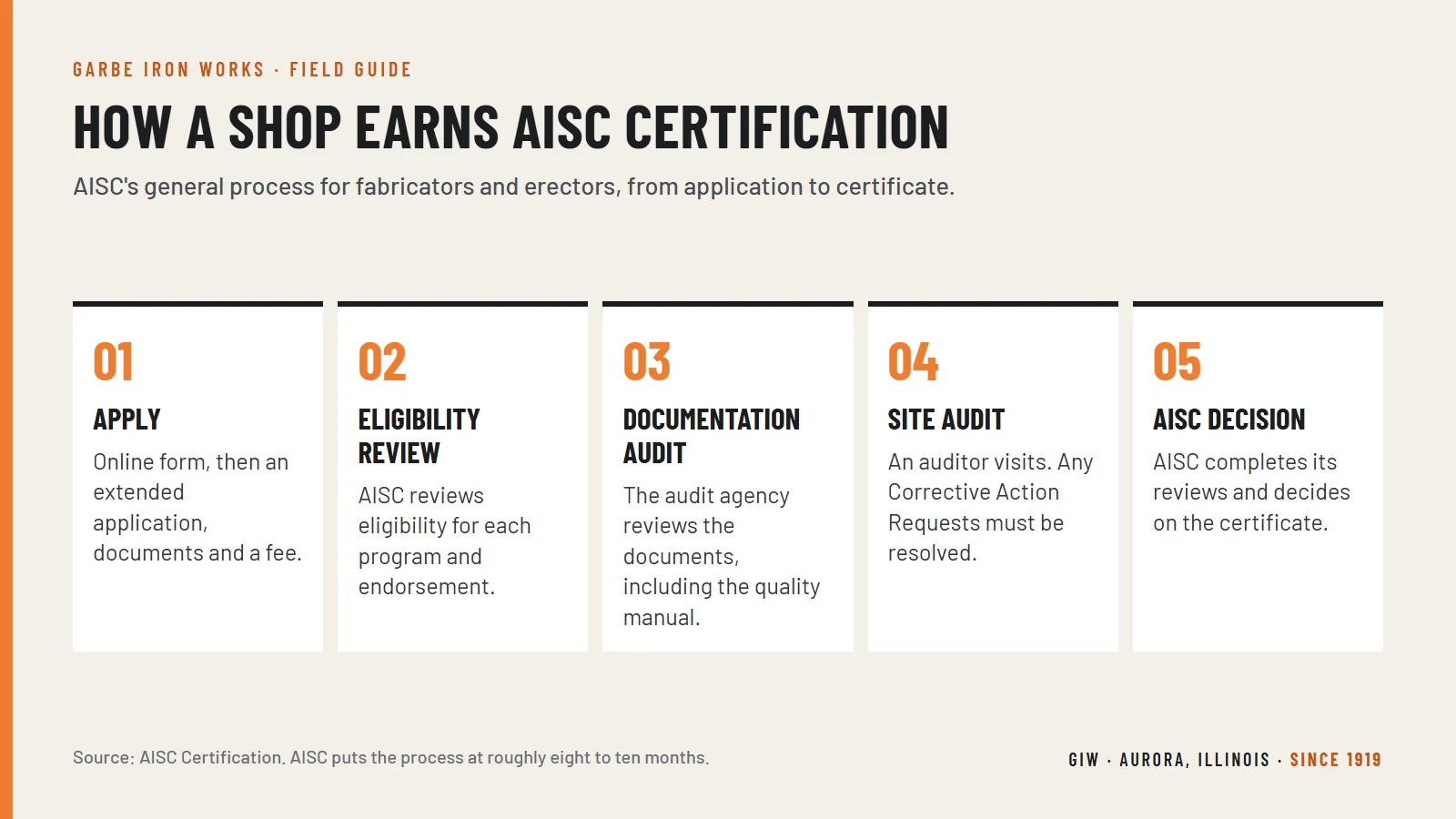
- Apply. The company completes AISC’s online application, then an extended application with its documents, such as the quality manual, and a fee.
- Eligibility review. AISC reviews eligibility for every program and endorsement applied for.
- Documentation audit. The audit agency reviews the submitted documents in depth, and the applicant resolves any deficiencies.
- Site audit. An auditor visits and may issue Corrective Action Requests (CARs) for deficiencies in the quality management system.
- Corrective actions. CARs are reviewed and must be resolved before findings go to AISC.
- Decision. AISC completes a series of reviews and determines certificate approval.
AISC puts the whole process at roughly eight to ten months, conservatively. For a GC, that means a fabricator that is not certified today is very unlikely to be certified in time for next month’s bid. Nor is it a one-time event for us: each year we take part in an AISC quality assurance audit performed by Quality Management Company.
AISC certification categories
AISC certifies by category. Building work falls under Certified Building Fabricator (BU). Bridge fabricators are certified as Simple (SBR), Intermediate (IBR) or Advanced (ABR), bridge and highway component manufacturers as CPT, hydraulic fabricators as HYDS or HYDA, and erectors as CSE. Optional endorsements cover fracture control and complex coatings.
| Category | What AISC says it covers |
|---|---|
| Building Fabricator (BU) | All aspects of structural steel fabrication, from contract receipt through final delivery, regardless of project size or complexity |
| Bridge Fabricator, Simple (SBR) | Unspliced rolled sections |
| Bridge Fabricator, Intermediate (IBR) | Typical bridges that do not require extraordinary measures, such as rolled beam bridges with splices |
| Bridge Fabricator, Advanced (ABR) | Bridges needing an added standard of care, such as box girders, arches and movable bridges |
| Bridge Component Manufacturer (CPT) | Metal components for bridge and highway work, such as bridge rail, stairs, walkways, bearings and expansion joints |
| Hydraulic Fabricator (HYDS, HYDA) | Hydraulic steel structures, at a standard or an advanced level |
| Erector (CSE) | A quality management system for all functions of steel erection, with optional bridge, metal deck and seismic endorsements |
| Fracture Control Endorsement (FCE) | Optional, for certified bridge fabricators and component manufacturers, based on the AWS D1.5 fracture control plan |
| Complex Coatings (CC-1, CC-2, CC-3) | Optional, for shop application of complex protective coating systems |
Source: AISC’s program descriptions for AISC certification.
A note on category names
Category names change. AISC has updated its program names, and its company search carries notes on the updates, so older specifications and company websites can carry older names. Our site lists GIW as certified for Steel Building Structures and as a Component Manufacturer – Bridge. Whatever name a spec or a website uses, AISC’s search is the place to confirm what a facility holds today.
Certified fabricators and certified erectors
They are separate certifications. A certified erector (CSE) has a quality management system that addresses all functions of structural steel erection, from receipt of the contract through completion of the work, with optional bridge, metal deck and seismic endorsements. A certified shop does not make the field crew certified, or the other way around.
That matters when your specification calls for both. We subcontract the on-site work and bring the erector onto our own project team. We work with the major erectors in this market, including several AISC Certified Erectors, and only bring in companies that take safety and customer service seriously. If your spec requires a certified erector, tell us at bid time. Our steel erection page explains how that works, and our guide to the steel erection sequence covers the field side.
AISC certification and special inspection under the IBC
Under the 2021 IBC, Section 1704.2.5 requires special inspection of fabricated structural items during fabrication, unless the fabricator has been approved under Section 1704.2.5.1. Approval rests on review of the fabricator’s written procedures and quality control manuals, with periodic auditing of its fabrication and quality control practices by an approved agency or the building official.
At completion of fabrication, an approved fabricator submits a certificate of compliance to the owner or the owner’s agent, for the building official, stating that the work was performed in accordance with the approved construction documents. Those provisions are in IBC Chapter 17. The exemption covers work on the fabricator’s premises. Section 1705.2.1 still ties special inspection and nondestructive testing of structural steel to the quality assurance requirements of AISC 360.
Who counts as approved is the building official’s call, not the fabricator’s. AISC certification produces the kind of evidence that section describes, a reviewed quality manual and audits by an independent agency, so ask your building department early whether it will accept it on your job. Also check which IBC edition your jurisdiction has adopted, since section numbers can move between editions.
Fabricator approval is also why a certificate of compliance and a mill test report are different papers. The MTR covers the material; our guide on how to read a mill test report walks through one.
When to require an AISC certified fabricator
Require it when you want an independently audited quality system behind the steel, and especially when you want to use the approved-fabricator path for special inspection during fabrication. The owner and engineer of record usually make that call in the specification. If you write it in, name the AISC category that fits the work.
- Building framing: Certified Building Fabricator (BU).
- Bridge members: the bridge category, SBR, IBR or ABR, that matches the bridge.
- Bridge and highway components such as rail, stairs and walkways: Bridge Component Manufacturer (CPT).
- Field erection: Certified Erector (CSE), plus an endorsement if the work calls for one.
A requirement only helps if it matches the work. A spec that names the wrong category, or a program name AISC no longer uses, leaves bidders guessing about what counts.
How to check a fabricator’s AISC certification
Use AISC’s Find a Certified Company search rather than a logo on a website. Certification is address-specific, so confirm the listing covers the facility that will actually build your steel, and that the category matches what your specification requires. Then ask who will erect the steel, and check that company the same way.
- Search for the fabricator in AISC’s directory.
- Match the listed address to the shop that will fabricate your job.
- Match the listed category to the one in your specification.
- Get the erector’s name and repeat the check if your spec requires a certified erector.
Our AISC certification
Garbe Iron Works holds continued certification from the American Institute of Steel Construction. Each year we take part in an AISC quality assurance audit performed by Quality Management Company, and we are certified for Steel Building Structures and as a Component Manufacturer – Bridge. Every welder is certified by the American Welding Society.
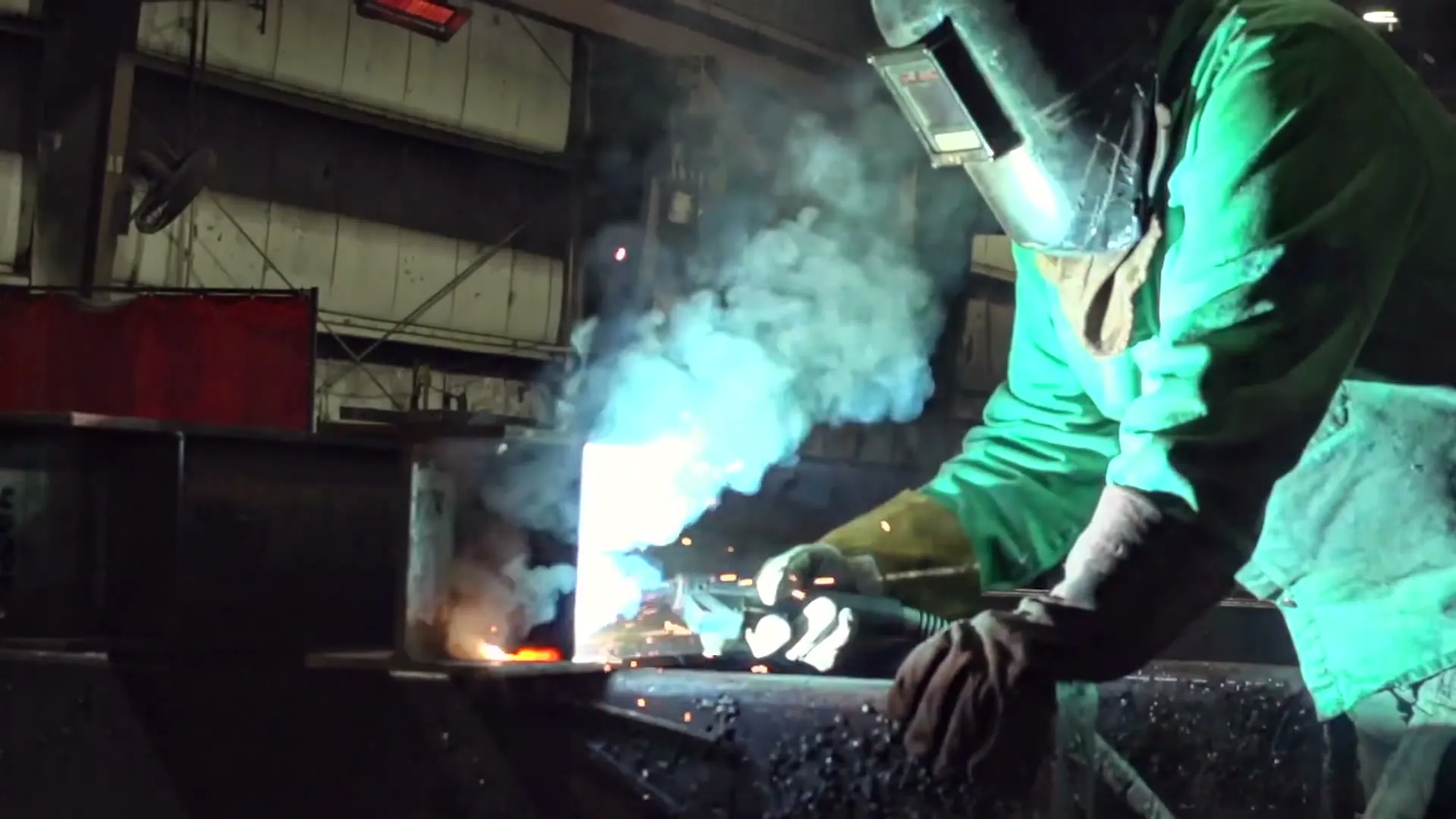
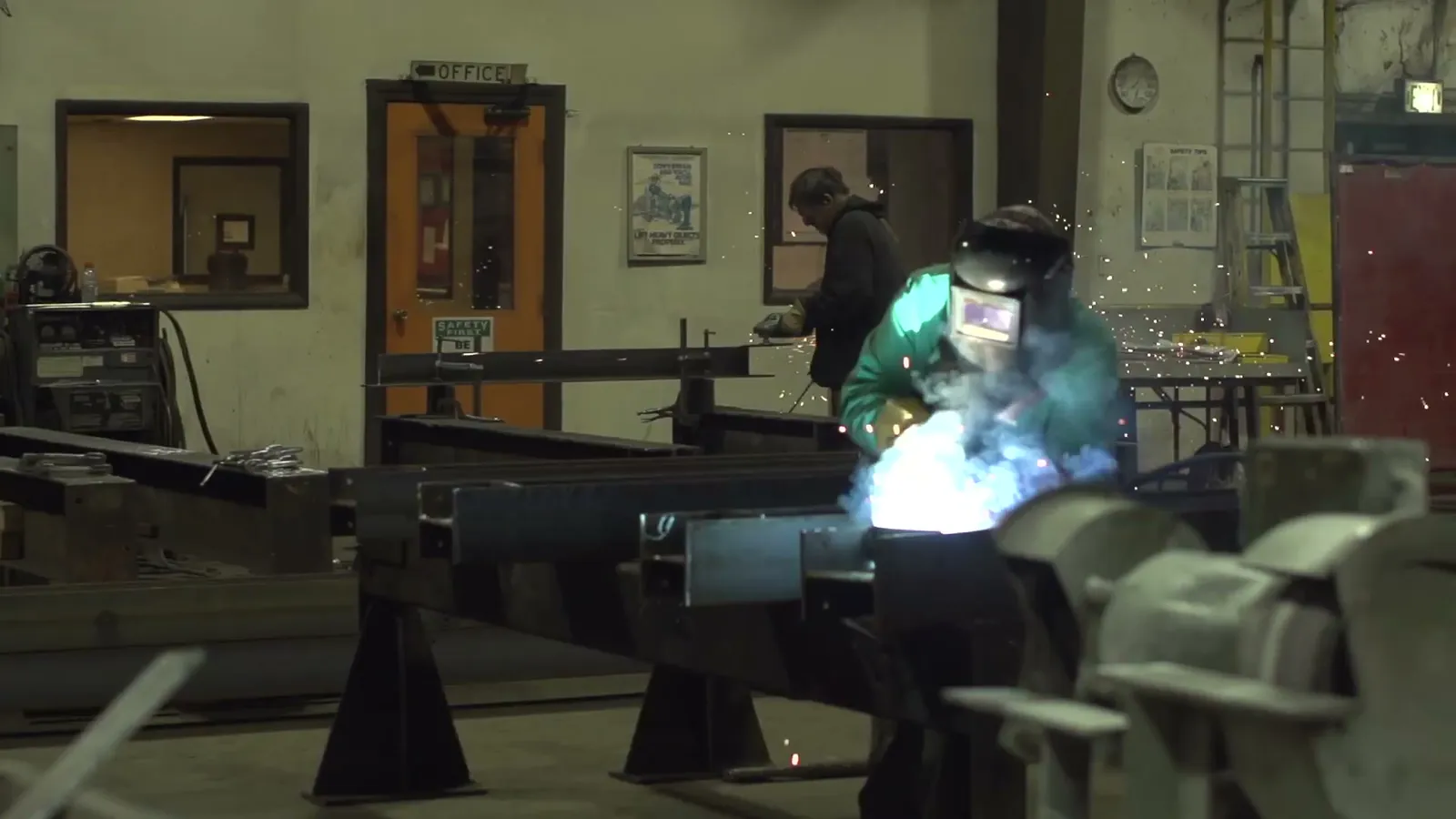
Welder certification is a separate credential from the shop’s AISC certification. Every GIW welder holds one, and we run nondestructive tests in our shop when contract specifications require them. Both are part of our structural steel fabrication work.
The same program covers the small pieces. Our miscellaneous steel, from stairs and railings to lintels and embeds, is built in the same shop, under the same AISC-audited quality program and with the same AWS-certified welders as our structural work.
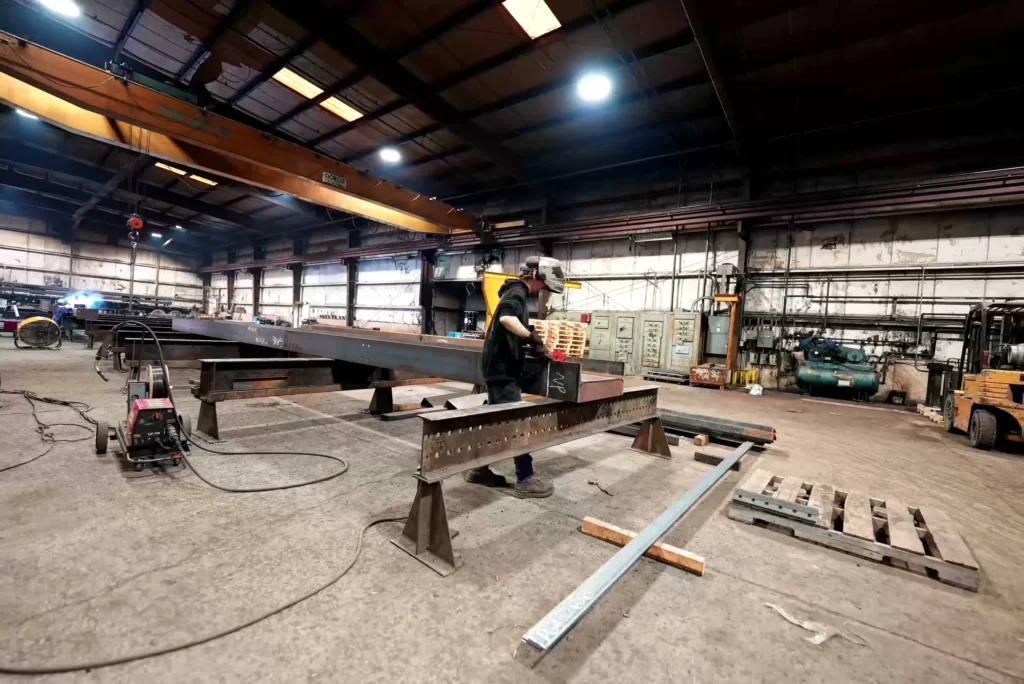
To see the shop behind the certification, read our guide to how structural steel is fabricated, step by step, or watch the film Peddinghaus shot on our floor.
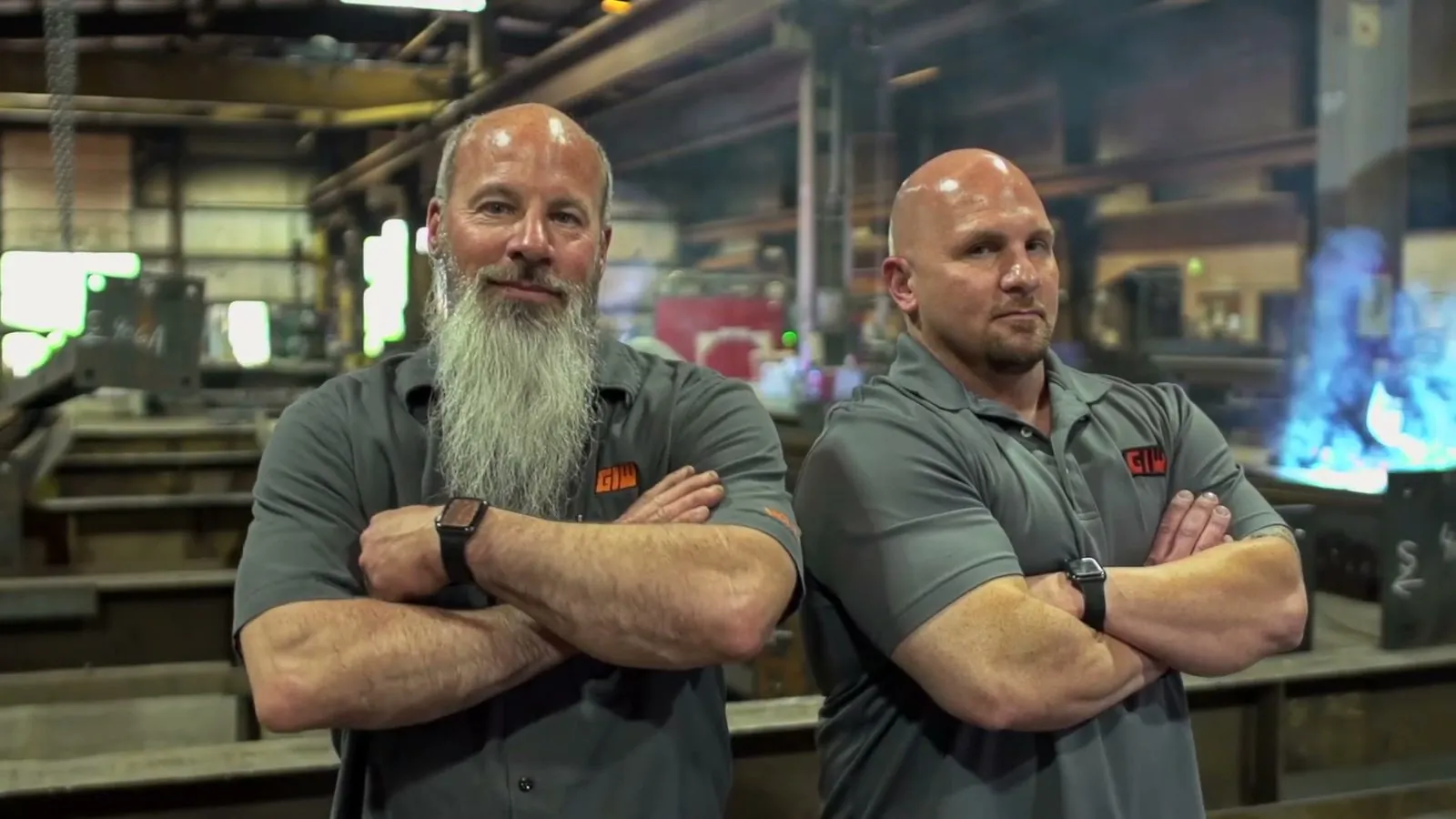 Watch: Maximizing Tonnage and Shop Floorspace (Peddinghaus, 4 min)
Frequently asked questions
What does AISC certified mean?
It means AISC has certified the company’s quality management system against its certification standard, after a documentation audit and a site audit by its independent audit agency, Quality Management Company. Certification is address-specific, so it applies to the facility that was audited.
Is AISC a design code?
AISC certification is not; it is a quality program. AISC also publishes design standards, including AISC 360, the Specification for Structural Steel Buildings, which is incorporated into U.S. building codes. Engineers design to AISC 360, and certification audits how a fabricator or erector controls its work.
When should you require an AISC certified fabricator?
When you want an independently audited quality system behind the steel, or the approved-fabricator path for special inspection during fabrication. Name the category in the specification, such as Certified Building Fabricator (BU) for building work.
Where can I find a list of AISC certified fabricators?
Use the Find a Certified Company search on AISC’s certification website. Confirm the listing covers the facility that will do your work and the category your specification requires.
Does AISC certification replace special inspection?
Not on its own. Under IBC Section 1704.2.5.1, special inspection during fabrication is not required at a fabricator approved by the building official, based on its written procedures, quality control manuals and periodic audits. The building official decides who is approved.
Need an AISC certified fabricator for your next job? Send us the drawings through our quote request form or call 630.897.5100. We quote full Division 5 packages and fabrication-only work.
About the publisher. Garbe Iron Works has detailed, fabricated and erected structural steel in Aurora, Illinois since 1919. We carry the full Division 5 scope out of a 32,000 sq. ft. CNC shop with more than 5,000 tons of annual capacity. GIW takes part in an annual AISC quality assurance audit performed by Quality Management Company, and every welder is certified by the American Welding Society.